This post contains affiliate links. As an Amazon Associate I earn from qualifying purchases, at no extra cost to you.
Cat urine marking is one of the most frustrating feline behaviour problems for owners to deal with — and one of the most commonly misunderstood. Understanding why cats mark, and distinguishing it clearly from other types of inappropriate urination, is the foundation of an effective solution.
What Is Urine Marking?
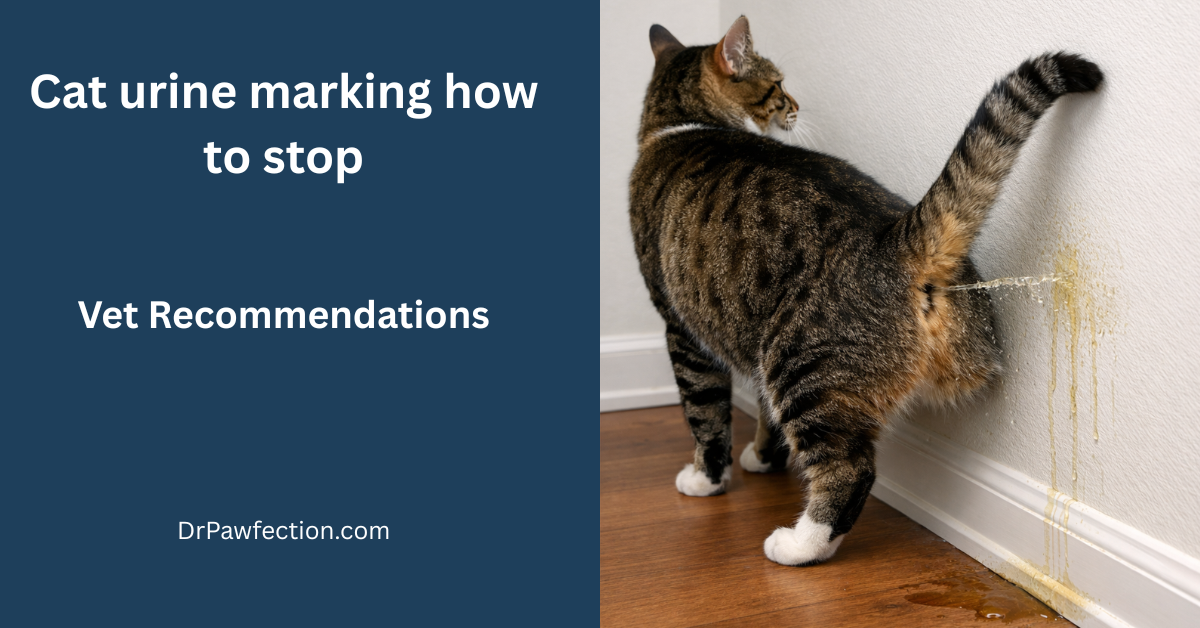
Urine marking is a deliberate communication behaviour. When a cat marks, they are depositing scent as a message — to other cats, and sometimes as a response to their own anxiety. It is a normal feline behaviour, even if it’s not one we want inside our homes.
Marking is most commonly associated with spraying: the cat stands with tail raised and quivering, and deposits a small amount of urine on a vertical surface. However, cats can also mark on horizontal surfaces, which makes it harder to distinguish from regular inappropriate urination.
How to Tell If It’s Marking or Urination
Key indicators that you’re dealing with marking rather than toileting behaviour:
- Small volume of urine deposited (marking) vs large volume (toileting)
- Urine on vertical surfaces — walls, doors, furniture legs (marking) vs horizontal surfaces (toileting)
- Cat continues to use litter box normally for most urination (marking)
- Multiple consistent locations that have social significance — near entry points, windows, owner’s belongings
- No scratching or covering behaviour after depositing urine
Why Cat Urine Marking Happens Indoors
The most common triggers for indoor marking include:
- A new cat or animal entering the household
- Neighbourhood cats visible or detectable through windows and doors
- Tension between cats in a multi-cat household
- Changes in the home — new people, new furniture, renovations, moving house
- The owner returning after an absence
- Intact (unneutered) status — this is the single biggest risk factor
The Role of Neutering
Approximately 90% of intact male cats will spray. Neutering resolves the behaviour in around 90% of cases — but this success rate drops significantly if neutering is delayed until after the behaviour has become well-established. If you have an intact cat that is marking, neutering should be the first step.
Approximately 5-10% of neutered cats of both sexes will also spray, usually for anxiety-related reasons.
Neutering is the single most effective intervention for cat urine marking in intact cats.
Environmental Management
Identifying and removing the source of the marking behaviour is the most effective long-term solution. If outdoor cats are triggering marking through windows, frosting lower windows or using motion-activated deterrents outside can reduce the visual stimulus.
In multi-cat households, ensuring adequate resources — separate food bowls, water stations, sleeping areas, and litter trays — reduces territorial tension. Cats that have to compete for resources will mark.
Cleaning Marked Areas
Marked areas must be cleaned with an enzymatic cleaner to neutralise the urine scent. Cats have a powerful sense of smell and will continue to return to and re-mark areas that still carry their scent, even in trace amounts undetectable to humans. Standard household cleaners are not sufficient.
Pheromone Therapy
Synthetic feline facial pheromone products such as the Feliway Classic Spray or the Feliway Classic 90 Day Diffuser can be helpful for anxiety-driven marking. These products mimic the calming pheromones cats deposit when rubbing their faces on objects, and can reduce the need to mark by reducing overall anxiety levels. They are not a complete solution on their own but work well as part of a broader management strategy.
Medication
For persistent or severe marking, particularly where the anxiety trigger cannot be removed, veterinary-prescribed anti-anxiety medication can be very effective. Anti-anxiety medications used for marking in cats include fluoxetine and clomipramine. These are typically used for a defined course rather than indefinitely, alongside behavioural management strategies.
If your cat’s marking is not responding to environmental management, please discuss medication options with your vet.
📋 Download the free Dr Pawfection Cat Health Checklist to monitor your cat’s behaviour and litter box habits daily.

Dr Jason Arlaud BVSc, B.Sc., M.Rep.Sci is a practising veterinarian with over 20 years of clinical experience treating dogs, cats, and small animals. He created Dr Pawfection to give pet owners access to reliable, vet-quality health advice they can use at home to keep their pets healthier for longer.
Leave a Reply to Why Is My Cat Peeing Outside the Litter Box? 7 Causes | Dr Pawfection Cancel reply